Mud flood & World Fairs: Secrets of a Buried Global Energy Network
Home | The Vault | Chronicles
We live in a world that has lost contact with its own foundations. While our ancestors aligned cathedrals, palaces, and entire cities according to the invisible laws of the Earth, the knowledge of telluric currents—those vast energetic flows that traverse our planet like a nervous system—seems to have been almost entirely forgotten.
This is not merely a manifesto about the past. It is a technical bridge. We look back at architectural masterpieces of an era often referred to as "Tartaria"—an epoch where aesthetics and energetic function were not adversaries, but a harmonic unity. These structures were not passive piles of stone; they were active resonators, generators, and spaces of healing.
In the following sections, we decode the mechanical and energetic principles that make it possible to understand a house not just as a shelter, but as a source of vitality. From precise magnetic alignment and the choice of proper building materials to understanding the subtle grid structures of our Earth, this is an invitation to see the world through the eyes of a Tartarian engineer.
It is time to leave behind the interference zones of the modern world and return to a laminar flow of energy. When we learn to build in harmony with the Earth, we are not just building houses—we are building a future that breathes.
The Great Reset and the Silent Horizon
This section establishes the foundation for operational sovereignty. The ruins of the past are not mere relics, but blueprints. To control energetic flows, one must first see through the architecture of deception that separated humanity from its heritage.
Forbidden Empire: Tartaria as a Technical Standard
To build the future, one must recognize the excellence of the past. Tartaria was not merely a nation; it was a global synchronization of energy and form. A worldwide architectural standard utilized domes, spires, and specific masonry patterns as functional interfaces for atmospheric energy.
These "power stations" were disguised as post offices, courts, and cathedrals. Architecture was not an aesthetic choice; it was a technical necessity for resonance.
Mud Flood: Salvaging Buried Technology
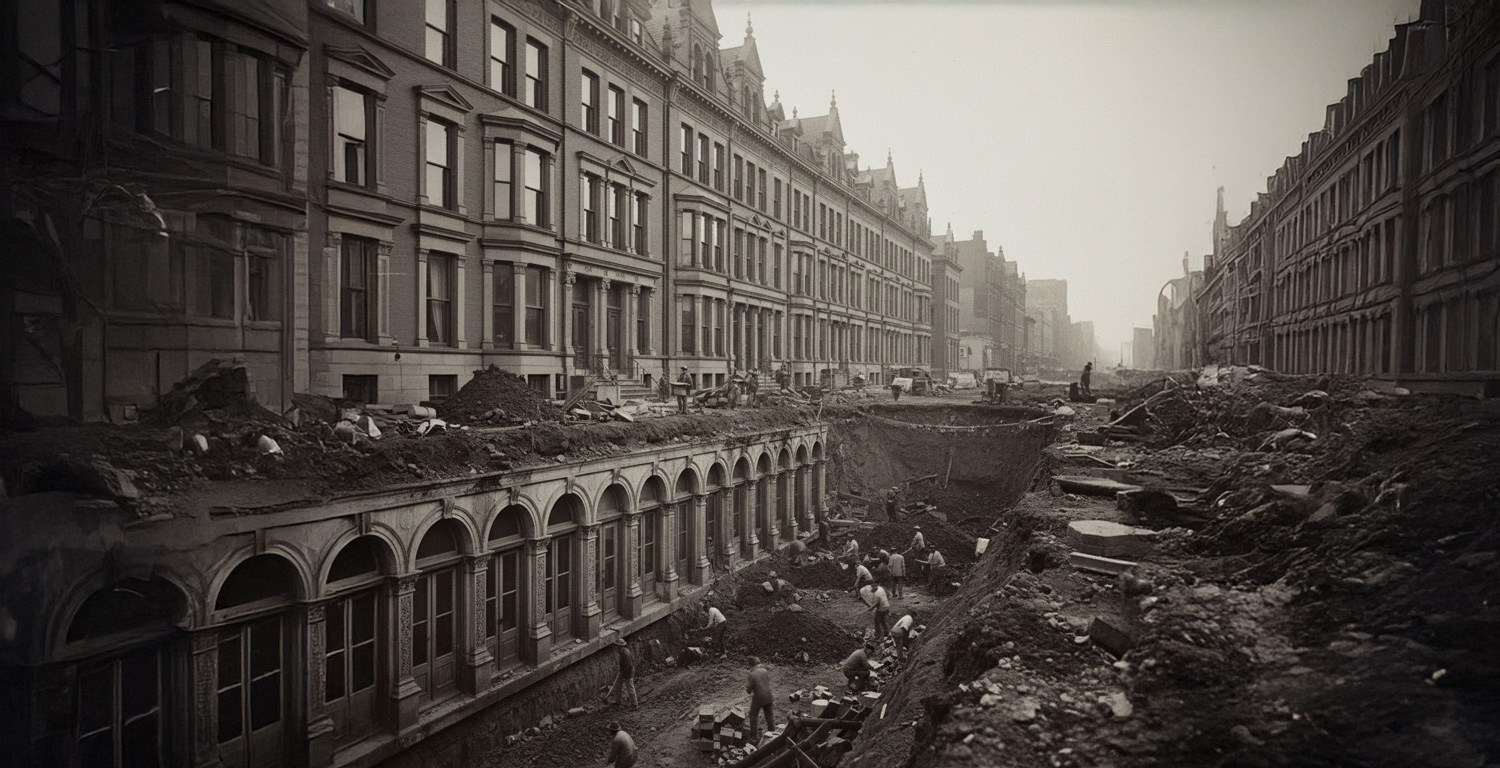
The "Great Reset" was not merely a historical shift; it was a physical cataclysm of global proportions. It left behind tangible scars often explained away as natural erosion or architectural trends. The "Mud Flood" represents a worldwide deposition of sediment that buried the primary ground floors of advanced structures under meters of clay and silt.
What is often dismissed as basements were in fact the energetic core of these buildings. These structures functioned as semiconductor systems, capturing atmospheric electricity and channeling it into resonance with the Earth.
Modern construction, in contrast, isolates buildings from natural energy through insulating materials and synthetic barriers. To reclaim autonomy, one must evaluate existing structures for their conductive potential.
Key diagnostic steps:
- Forensic window analysis: identify buried arches and restricted openings.
- Sub-surface material continuity: examine conductive materials like brick or sandstone.
- Telluric anchor identification: locate deep-set iron anchors.
- Hydro-electric mapping: assess proximity to underground water.
- Insulation audit: detect modern materials that block energy flow.
Architecture is not passive shelter—it is a functional interface designed to harmonize human life with terrestrial and cosmic forces.
The World Fairs: The Protocol of Dismantling
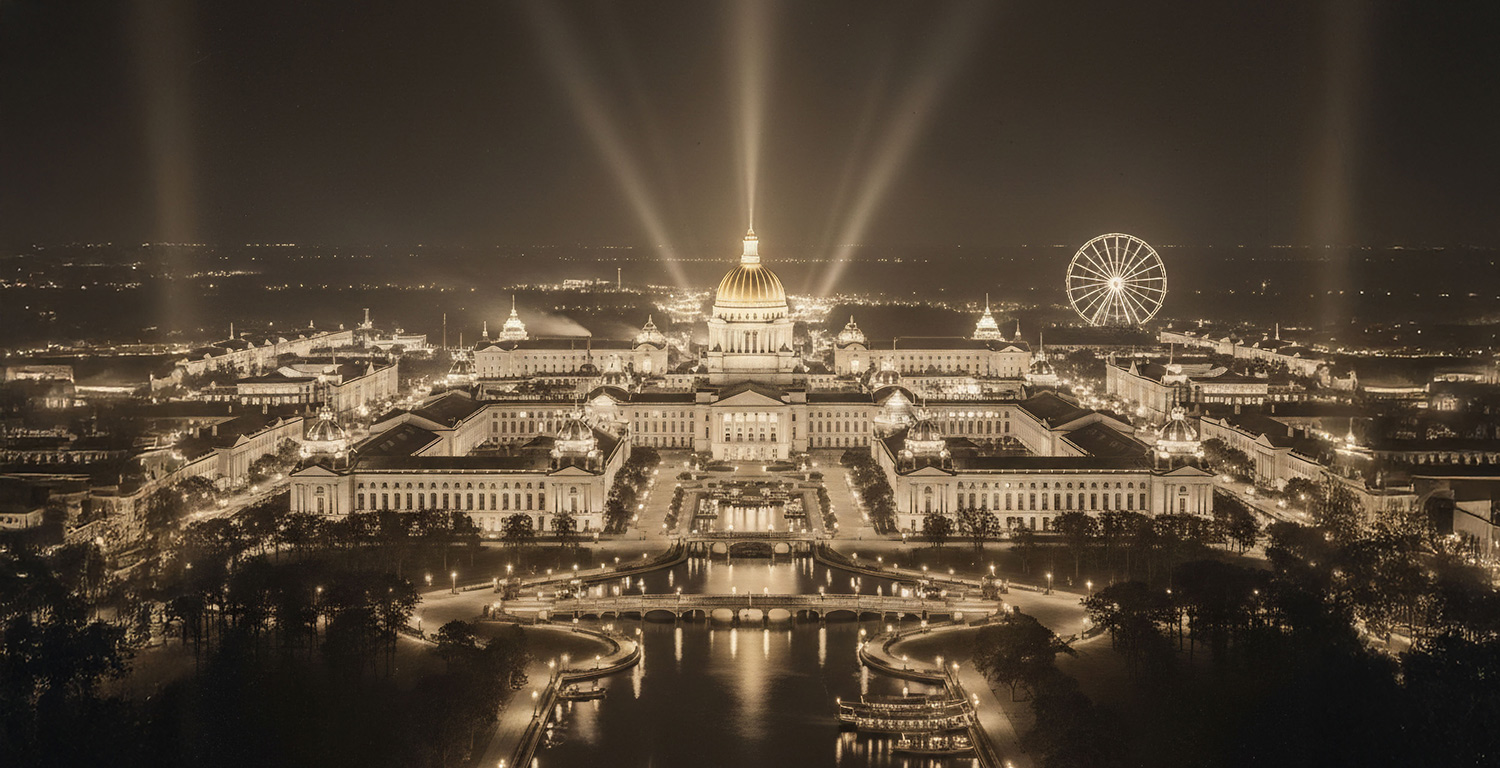
The World Fairs between 1851 and 1915 were not celebrations of progress, but staged dismantling events. Pre-existing advanced infrastructure was presented as temporary achievement before being destroyed.
The so-called "White Cities" were fully functional energy hubs, not temporary constructions. Their demolition marked the transition from free atmospheric energy to controlled, metered systems.
Key indicators of this process:
- The temporary material fallacy: advanced structures mislabeled as plaster constructions.
- Aetheric illumination: widespread lighting without established power grids.
- Fire narrative: systematic destruction via suspicious fires.
- Logistical impossibility: construction timelines that defy reality.
- Transition to scarcity: shift to wired, metered energy systems.
This reveals the modern world as a simplified overlay on a more advanced past.
The Restoration of Knowledge
The final stage of the reset involved the erasure of knowledge. Modern scientific frameworks removed key energetic principles. This section restores awareness of telluric currents and aetheric dynamics, shifting from scarcity toward abundance.
The Lost Heritage: Architecture as a Living Organism
Modern structures are not designed to sustain life but to isolate it. They function as energy sinks, disconnected from natural systems and dependent on centralized grids.
In contrast, historical architecture functioned as aetheric resonators. Buildings were conceived as living systems—extensions of human energy fields.
Materials such as brick, limestone, and copper were selected for their conductive properties, forming passive circuits that interacted with universal energy.
The Aetheric Principle: Understanding the Delta between Nature and Habitat
The crisis of modern living lies in the growing gap between natural Earth resonance and artificial environments.
Traditional structures allowed natural frequencies to pass freely. Modern materials create barriers that block these frequencies while trapping electromagnetic pollution.
To bridge this gap:
- Conduction: reconnect soil and structure.
- Resonance: apply harmonic proportions such as the golden ratio.
- Accumulation: transform buildings into energy storage systems.
The Vision of the Estate: From Passive Consumer to Active Power Generator
This is an invitation to transition from dependency to sovereignty. An estate can function as a closed-loop system of energetic independence.
This transformation unfolds in three layers:
- The telluric layer: aligning with Earth’s energy flows.
- The structural layer: enhancing the building’s energetic interface.
- The vital layer: transforming land into a regenerative system.
The goal is not theoretical understanding, but practical transformation—turning living spaces into active, life-supporting systems.