The Great Tartary: Recovering the World’s Deleted Superpower
Home | The Vault | Lost Knowledge
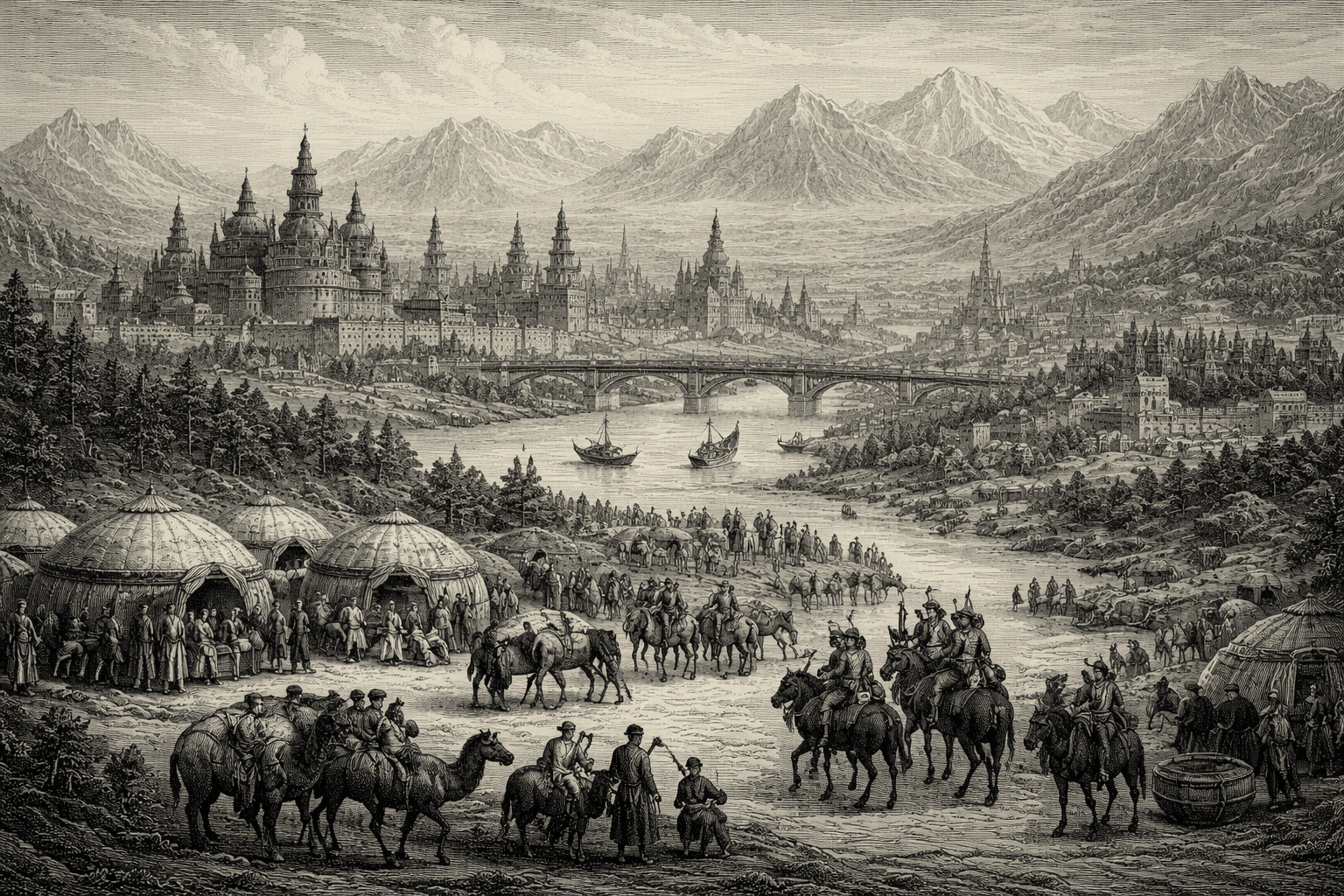
If you open a modern history book, you will find a vast, sterile void across Northern Asia and parts of the Americas prior to the 19th century. We are taught that these regions were sparsely populated by nomadic tribes, lacking centralized government or advanced infrastructure. However, if you step outside the modern curriculum and examine the rare cartography of the 16th, 17th, and 18th centuries, a staggering contradiction emerges. Dominating the landscape is not a wilderness, but a massive, sovereign entity that dwarfed the European powers of the time: Grand Tartaria.
Beyond a Geographic Label: A Sovereign Civilization
Mainstream historians often attempt to dismiss "Tartary" as a vague, archaic geographical term—a simple "catch-all" for the vast steppes of Eurasia. Yet, the primary sources tell a far more complex and organized story. The Geneva Encyclopedia of 1771, and even the first edition of the Encyclopedia Britannica, described Tartary as a vast country in Northern Asia, bounded by Siberia on the north and the Pacific Ocean on the east.
Tartaria was not merely a region; it was a state with all the trappings of a global superpower. It possessed recognized flags, most notably the yellow banner featuring a black owl or a dragon. These weren't tribal symbols; they were maritime and state ensigns documented in official French, British, and Dutch naval charts of the era. Furthermore, accounts from early explorers describe a sophisticated legal system and a hierarchy of leadership that maintained order over thousands of miles, facilitating transcontinental trade long before the modern era.
The Cartographic Erasure: A Geopolitical Reset
How does an empire larger than the Russian Empire and the United States combined simply disappear from the collective memory? The shift occurred with surgical precision during the mid-1800s. Between 1850 and 1900, world maps underwent a radical transformation. The name "Tartaria" began to be systematically replaced by "Russia," "Mongolia," and "China."
This wasn't just a natural shift in borders; it was a geopolitical reset. By re-drawing the maps, the victors of the 19th-century conflicts—primarily the Romanovs and the British Empire—could standardize a new narrative. The Tartarian lineage was strategically reclassified. High-ranking officials and city-dwellers were erased from the records, while the remaining population was framed as "nomadic barbarians" to justify the colonial "civilizing" missions of the new world powers. This erasure turned a thriving, centralized superpower into a "frontier" waiting to be conquered.
The Star Forts and the Global Infrastructure
The most damning evidence of the Tartarian Empire isn't found in books, but in stone. Throughout the former territories of Great Tartary—stretching from the plains of Siberia into the American West—lie the remnants of Star Forts. Mainstream history claims these complex, geometrically perfect bastions were built by European settlers to defend against primitive tribes.
However, the sheer mathematical precision and the massive scale of these fortifications suggest a different origin. These sites are often found at strategic energetic nodes, mirroring the "classical" architectural style found in Paris, London, and Washington D.C. This points to a unified global culture—the Tartarian legacy—that shared a common architectural and energetic blueprint. These were not just defensive structures; they were part of a sophisticated network of cities that utilized the earth’s natural resonance.
The High-Tech Legacy: Master of the Aether
While the "nomadic" narrative is pushed to explain away the lack of industrial records, the architecture Tartaria left behind hints at a technology we are only beginning to understand. The grand domes, spires, and "antiquitech" antennas found on Tartarian buildings were not merely decorative. Evidence suggests that this empire had mastered the use of Aetheric energy—the extraction of wireless power from the atmosphere.
This explains how they could maintain a global civilization with massive, heated stone structures in the coldest regions of the planet without the visible coal or oil infrastructure we rely on today. When the empire fell, this free energy technology was dismantled, and the world was forced into the age of fossil fuels and metered power. The destruction of Tartaria was, in essence, the destruction of energy independence for humanity.
Why the Silence?
The suppression of Tartaria is the suppression of our true potential. If the public were to realize that a peaceful, technologically advanced, and globally connected civilization existed only 200 years ago, the current structures of power would be questioned. Tartaria represents a "lost timeline"—a world where architecture was healing, energy was free, and history was not one of constant, primitive struggle, but of high-order civilization.
We are currently in the process of digging this empire out of the mud of lies. Every map found, every star fort identified, and every "classical" building questioned is a step toward reclaiming a heritage that belongs to all of us. The Vault remains committed to documenting these fragments until the full picture of our suppressed past is restored.